

The job market in 2026 is uncertain yet quick. On one hand, technology has made searching and applying for roles faster and more accessible than ever. On the other hand, the hiring process itself continues to drag, creating frustrating delays for both companies and candidates. This slowdown isn’t just a minor inconvenience; rather, it’s a serious weak spot that explains why so many recruiters end up losing promising talent along the way.
Now, when we look at the lifecycle of a high-performing candidate, we see a window of opportunity that is remarkably narrow. If your organization takes more than a week or two to move from application to engagement, you are effectively operating in a ghost town where all cream talents have already moved on to your competitors.
The concept of the 10-day delay is not an arbitrary number. It represents the psychological and professional threshold where a candidate shifts from being an active, excited applicant to a frustrated job seeker looking elsewhere. For a company or a large-scale enterprise, ten days might feel like the blink of an eye. It is the time it takes for two managers to sync their calendars, or for an HR specialist to finish a busy week of internal meetings.
On the other hand, ten days is an eternity for a top-tier software engineer, a brilliant marketing strategist, or a high-impact sales executive. Understanding why recruiters lose candidates often comes down to this exact window of silence. In those ten days, they have likely received three LinkedIn messages from recruiters, completed two screening calls, and possibly even sat for a final interview with a more agile firm.
Are you losing top candidates due to slow hiring decisions?
A Candidate’s Psychology of the Waiting Game
We must understand the mind of the top-tier resource. These are individuals who are not just looking for a paycheck; they are looking for a culture of excellence. When a candidate submits an application and hears nothing for ten days, they do not think the company is busy. They think the company is disorganized. They assume the internal processes are broken, and they fear that if hiring is this slow, the day-to-day work will be just as frustrating.
Speed is a form of respect. When an organization responds quickly, it demonstrates that it values the time and talent of the professional it claims to want. Conversely, a delay of ten days acts as a silent rejection. It sends a message that the candidate is just another number in a database, easily forgotten or ignored.
Now, in an era where employer branding is vital for success, this silence is toxic. This is exactly why recruiters lose candidates to rivals because they are not shortlisting right candidates faster than rivals.
The Real Cost of Slow Screening
Let us look at the hard numbers. The cost of a vacancy is a metric that many HR departments fail to track accurately, yet it is one of the most significant drains on corporate revenue. When a position remains open because the screening process is too slow to catch the best talent, the burden falls on the rest of the team. This leads to burnout, decreased morale, and a drop in the quality of work.
If an enterprise loses a top candidate because of a 10-day delay, they are forced to settle for their second or third choice. Research has shown that the difference in productivity between a top-tier performer and an average performer can be as high as 400%. When you move slowly, you lose a person as well as massive amounts of future output and innovation.
Hence, to avoid this, companies must look into how recruiters reduce hiring time through modern tools and even in volume hiring screen candidates quickly. You are essentially paying the same salary for a significantly lower return on investment.
Statistics from the Front Lines of Hiring
Industry magazines and HR research groups have published startling data that confirms the dangers of a slow process.
Let us examine some of the most relevant findings:
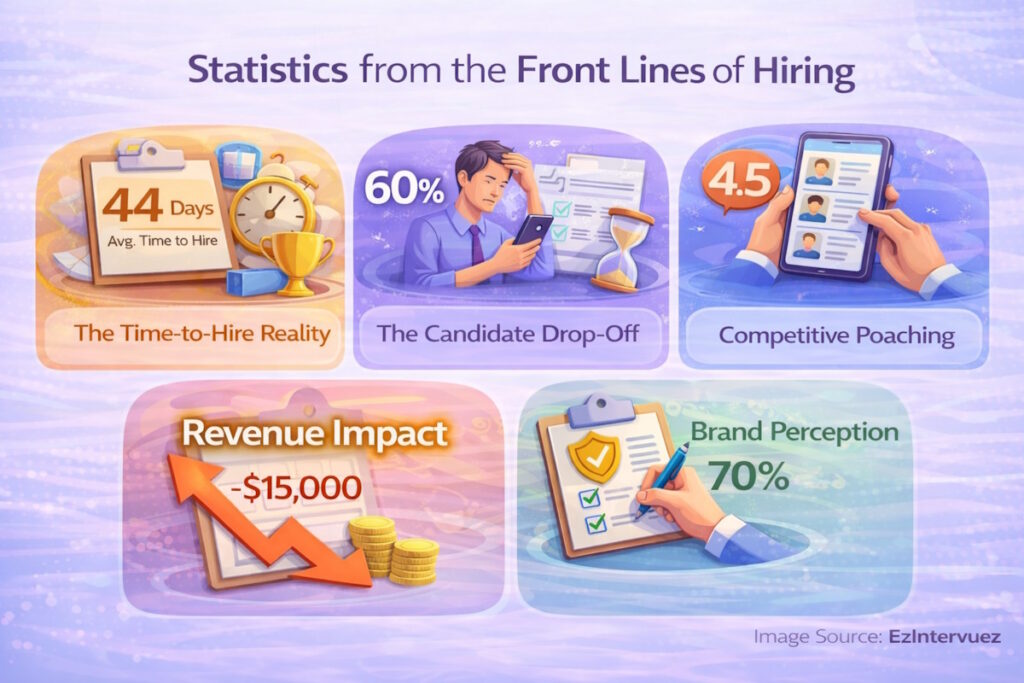
- The Time-to-Hire Reality: According to reports in leading business journals, the average time to hire across all industries has stretched to 44 days. However, the most successful 5% of companies have managed to keep their screening-to-offer window under 14 days by implementing a fast-hiring process for recruiters. This gap represents the primary competitive advantage in the war for talent.
- The Candidate Drop-Off Rate: Recent surveys indicate that 60% of job seekers have quit a hiring process because it took too long. This highlights exactly why recruiters lose candidates during the early stages of engagement. This is not because they were no longer interested in the role, but because the lack of momentum killed their enthusiasm.
- Competitive Poaching: Data from recruitment analytics firms shows that top talent receives an average of 4.5 interview requests within the first week of their job search. If your screening delay reaches ten days, the probability of that candidate being available drops by nearly 80%. This is why an AI interview platform for recruiters has become so critical for staying competitive.
- Revenue Impact: Many major publications have highlighted that a bad hire, often the result of settling after the best candidates are gone, can cost a company over $15,000 on average. When you factor in the cost of a missed top-performer, the lost revenue can reach into the hundreds of thousands for specialized roles.
- Brand Perception: A study by LinkedIn found that 70% of candidates say a positive interview experience makes them more likely to accept an offer. A significant part of that experience is the speed and clarity of communication during the initial screening. Understanding how recruiters reduce hiring time is, therefore, a brand-building exercise.
What if you could screen and shortlist candidates within 24 hours?
Why Traditional Screening Methods Are Failing
The reason most organizations suffer from the 10-day delay is that they are still using manual, 20th-century methods to solve 21st-century problems. Human recruiters are overwhelmed. A single job posting for a remote role can attract thousands of resumes. Expecting a human to manually screen every single one, check for qualifications, and then coordinate schedules for a call is unrealistic. It is a recipe for burnout and, inevitably, delay.
Manual screening is also subject to human bias and inconsistency. A recruiter might be more lenient on a Monday morning than on a Friday afternoon. This inconsistency means that even if you do catch a candidate within ten days, you might not be evaluating them fairly or accurately.
Ultimately, the sheer volume of data is simply too much for manual processes to handle at the speed required by the modern market. This is why recruiters lose candidates who are simply tired of waiting for a human to clear their inbox.
The Rise of HR Candidate Screening Automation
This is where technology steps in to save the day. AI interview platforms helps recruiters and candidate screening automation is no longer a luxury item; they are essential infrastructure for any company that wants to stay relevant.
Today, automation allows an enterprise to scale its hiring efforts without increasing its headcount. It provides a way to interact with every single applicant instantly, ensuring that no one falls through the cracks during those first critical 10 days.
Automation tools can perform tasks that would take humans weeks. They can analyze resumes for specific skill sets, conduct initial video screenings, and even evaluate technical proficiency through automated coding or writing assessments. By moving these tasks to an AI interview platform for recruiters, HR teams can focus their energy on the final stages of the hiring process, such as building relationships and closing the deal with the best candidates.
Transforming the Workflow with EzIntervuez
To combat the 10-day talent drain, forward-thinking organizations are turning to specialized platforms like EzIntervuez. This is not just another recruitment tool; it is a comprehensive AI interview platform for recruiters designed to eliminate the bottlenecks that cause companies to lose out on top talent. Visit EzIntervuez to see exactly how the future of hiring is being built.
EzIntervuez is built to handle the heavy lifting of the screening phase. It allows organizations to move at light speed, ensuring that a candidate who applies on Monday can be fully screened and ready for a final interview by Wednesday. This rapid turnaround is what keeps top talent engaged and off the market, showing exactly how recruiters reduce hiring time in the real world.
Core Features of the EzIntervuez Platform
When you integrate EzIntervuez into your hiring strategy, you gain access to a suite of features that directly address the 10-day delay and facilitate a fast-hiring process for recruiters:
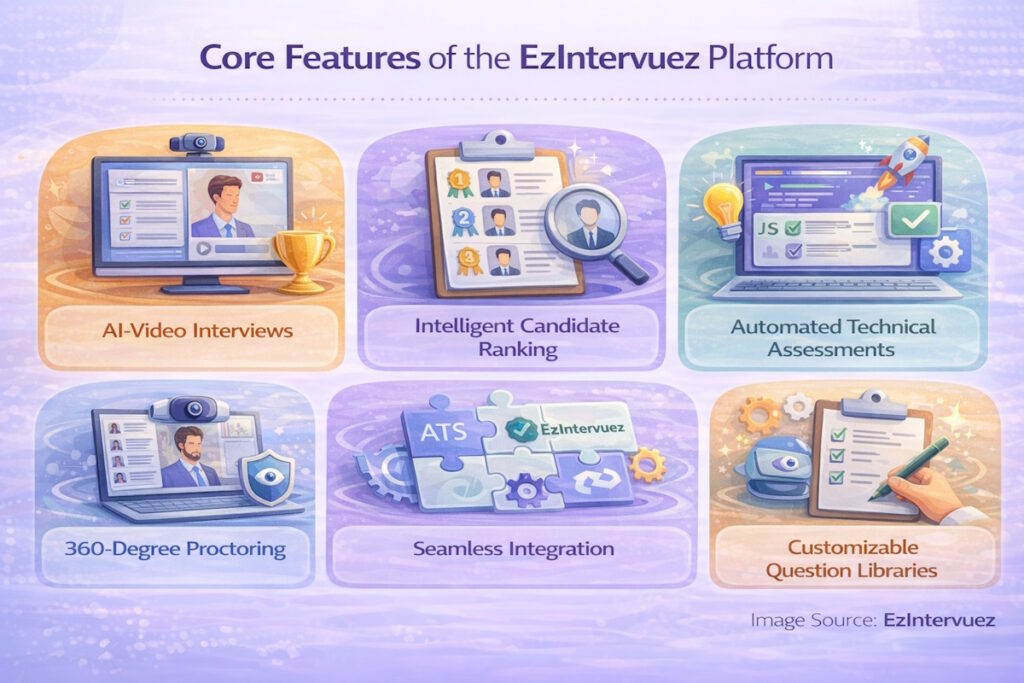
- AI-Video Interviews: One of the biggest delays in hiring is the back-and-forth of scheduling a phone screen. With this AI interview platform for recruiters, you can set up asynchronous video interviews. Candidates record their answers to your questions on their own time. This removes the need for manual scheduling and allows your team to review candidates in minutes rather than days.
- Intelligent Candidate Ranking: The platform uses advanced AI to analyze candidate responses and resumes. It provides a ranked list of the best fits based on the specific needs of your role. This is a primary way recruiters reduce hiring time, as they no longer have to guess who to call first.
- Automated Technical Assessments: For technical roles, EzIntervuez offers built-in coding environments and skill tests. These are automatically graded, providing instant feedback on a candidate’s actual ability. This ensures a fast-hiring process for recruiters who need to verify hard skills quickly.
- 360-Degree Proctoring: To ensure the integrity of the process, the platform includes sophisticated AI proctoring tools. This prevents cheating and ensures that the person you are screening is the person who will show up for work.
- Seamless Integration: EzIntervuez is designed to work with your existing Applicant Tracking Systems. It acts as a powerful engine that speeds up your current workflow without requiring a total overhaul of your HR tech stack.
- Customizable Question Libraries: You can create specific interview paths for different roles, from sales to engineering. The AI can even help you generate the best questions to ask to uncover the true potential of each applicant.
The Competitive Advantage of Candidate Screening Automation
Using EzIntervuez, a company can effectively shrink its screening window from 10 days to under 24 hours. Imagine the impact this has on your recruitment brand. A candidate applies, and within an hour, they receive an invitation to a video screen via an AI interview platform for recruiters. They complete it that evening, and by the next morning, they have a personal message from a hiring manager to schedule a final round. This is the gold standard for a fast-hiring process for recruiters.
This speed creates a sense of momentum. It tells the candidate that your company is high-energy, decisive, and seriously interested in their skills. It often results in the candidate prioritizing your offer over others, simply because you were the first to show real commitment. If you are wondering how recruiters reduce hiring time, the answer is clearly found in this kind of radical efficiency.
Furthermore, automation through EzIntervuez removes the subconscious biases that often slow down human decision-making. The AI looks at data, skills, and performance. This leads to a more diverse and capable workforce, which is a key driver of success in 2026. Understanding why recruiters lose candidates often reveals that slow, biased manual reviews are the culprit.
Breaking the Cycle of Talent Loss
The 10-day rule is a warning for every enterprise leader. If you continue to rely on slow, manual screening processes, you will continue to watch your best potential hires sign on with your competitors. You will be left with the candidates who were willing to wait, which often means they didn’t have any other options. This is why recruiters lose candidates that could have transformed their business.
The solution is clear. You must automate the top of your hiring funnel. You must use AI to handle the volume so that your humans can handle the relationships. A fast-hiring process for recruiters is no longer a dream; it is a reality with the right technology. Platforms like EzIntervuez provide the bridge between a crowded applicant pool and a high-performing team.
When you reduce the time it takes to screen a candidate, you do more than just fill a role faster. You save money, you boost team morale, you strengthen your company culture, and you ensure that the best resources in the market are working for you instead of against you. Discovering how recruiters reduce hiring time is the first step toward building a dominant market position. The cost of waiting is simply too high.
Stay Ahead EzIntervuez, an AI-Powered Candidate Screening Tool
In the high-stakes world of modern business, speed is the ultimate currency. A 10-day delay in screening is a luxury no organization can afford. It is a direct path to mediocrity and a primary reason why recruiters lose candidates. Implementing AI-powered screening and leveraging the robust features of an AI interview platform for recruiters like EzIntervuez, you can reclaim your time and secure the talent that will define your company’s future.
Stop letting 10 days stand between you and your next superstar. The technology to fix this problem exists, and it is more accessible than ever before. It is time to move from a reactive hiring model to a proactive, automated powerhouse with a fast-hiring process for recruiters.
