


Preparing well for a software interview can be the difference between landing your dream job and missing out. In 2026, software interviews are changing: interviewers now blend technical rigor with behavioral analysis, system design problems, and communication skill evaluations. AI powered interviews are the thing today.
To help you feel confident and ready, here are ten essential software interview questions that keep appearing across startups, product firms, and global tech giants. Plus, a guide to how tools like EzIntervuez offering AI powered interviews can help you practice smarter.
Ready to experience how AI can transform your Software Interview prep?
Understanding Software Interviews in 2026
Software interviews in 2026 go beyond coding skills to evaluate your problem-solving, system design, adaptability, and communication. Employers seek engineers who think strategically about scalability and real-world challenges while collaborating clearly. Hybrid and AI powered interview process are now common.
Software interviews aren’t just about coding under pressure anymore. Today, employers assess:
- Technical skill and problem-solving
- System design capability and scalability thinking
- Familiarity with real-world development practices
- Communication: clear, collaborative, solution-focused answers
- Adaptability and culture fit
Emerging trends like AI powered interviews, AI-driven assessments, asynchronous coding rounds, and virtual interview tools are making the experience more holistic and efficient for both candidates and recruiters.
The 10 Must-Prepare Software Interview Questions
Mastering these ten interview questions helps you stand out to today’s employers who value adaptability, clear technical reasoning, and teamwork. These questions are selected for their frequent use in major companies, covering both core programming skills and modern workplace needs. Answering them confidently can set the tone for a successful interview experience.
Let’s break down the ten core questions—what they cover, why they matter, and how you can approach them.
1. Explain Data Structures You Use Most (With Real Examples)
Why it’s asked: Data structure knowledge is crucial for solving technical problems quickly and efficiently. Interviewers want to see not just textbook knowledge but practical usage.
How to handle it:
Briefly define key structures (arrays, linked lists, trees, graphs), then explain where you used each in past projects—for example, how a hash map helped you speed up database lookups, or how you used stacks for undo features.
2. Solve a Coding Problem Live (e.g., Reverse a Linked List)
Why it’s asked: Demonstrates programming fluency, logical thinking, and ability to communicate your thought process.
How to handle it:
Practice common problems like reversing arrays or lists, finding the largest/smallest elements, or sorting algorithms. Use clear, well-commented code and explain each step as you go.
3. Design a Scalable System (e.g., URL Shortener or File Storage)
Why it’s asked: Companies need engineers who can think beyond code—considering performance, redundancy, and real-world bottlenecks.
How to handle it:
Outline your system’s main components, describe how you’d handle scaling (load balancing, caching), and mention any trade-offs in your design.
4. Debug a Piece of Code or Explain a Bug You Fixed
Why it’s asked: Shows practical experience, a methodical approach to troubleshooting, and a deep understanding of how systems behave under stress.
How to handle it:
Walk through the bug, how you identified it, what tools you used, and how your fix improved reliability or performance.
5. Describe Your Approach to Testing and Quality (e.g., Unit, Integration, Black Box/White Box)
Why it’s asked: Good engineers test their code and prevent defects early.
How to handle it:
Briefly explain different testing types, then share how you’ve implemented or automated tests in past projects, and why that improved codebase stability.
6. Implement an Algorithm (e.g., Depth-First Search, Binary Search)
Why it’s asked: Algorithm knowledge underpins everyday decision-making and technical interviews.
How to handle it:
Review core algorithms and be ready to write or whiteboard them quickly. Focus on efficiency and clarity, discuss time and space complexity, and identify cases when you’d choose one approach over another.
7. Discuss an Object-Oriented Programming (OOP) Principle (e.g., Inheritance, Polymorphism)
Why it’s asked: Modern codebases rely heavily on OOP principles for maintainability and collaboration.
How to handle it:
Define the main principles, and then, with a simple example, describe how you used abstraction or encapsulation to solve a real project problem.
8. Compare Functional and Non-Functional Requirements
Why it’s asked: Understanding both is key to effective software design.
How to handle it:
- Functional Requirements: What the system must do (features, functions)
- Non-Functional Requirements: How the system performs (scalability, security, usability)
- Use a sample from your experience, like meeting both data security and user login requirements.
9. Collaborate Out Loud: Communicate a Solution or Idea to a Peer
Why it’s asked: Communication and teamwork are mission-critical.
How to handle it:
Role-play explaining a feature to a team member who isn’t technical, or talk through how you resolved a design disagreement. Focus on clarity, empathy, and logical sequencing.
10. Share a Challenge and How You Grew from It
Why it’s asked: Assesses personal growth, stress management, and adaptability.
How to handle it:
Choose a challenge where you learned something. Maybe, adopting a new framework under tight deadlines, or handling unexpected production bugs, and highlighting what you’d do differently now.
Key Strategies to Outperform in 2026 Software Interviews
Excelling in software interviews takes more than just technical knowledge. It requires practice, structure, and situational awareness. In 2026, an AI interview platform is on the rise that helps prepare candidates with industry-ready questions. This is because interviewers value candidates who can communicate complex ideas clearly, demonstrate adaptability, and show evidence of teamwork.
Using real stories and practical examples makes answers memorable and genuine.
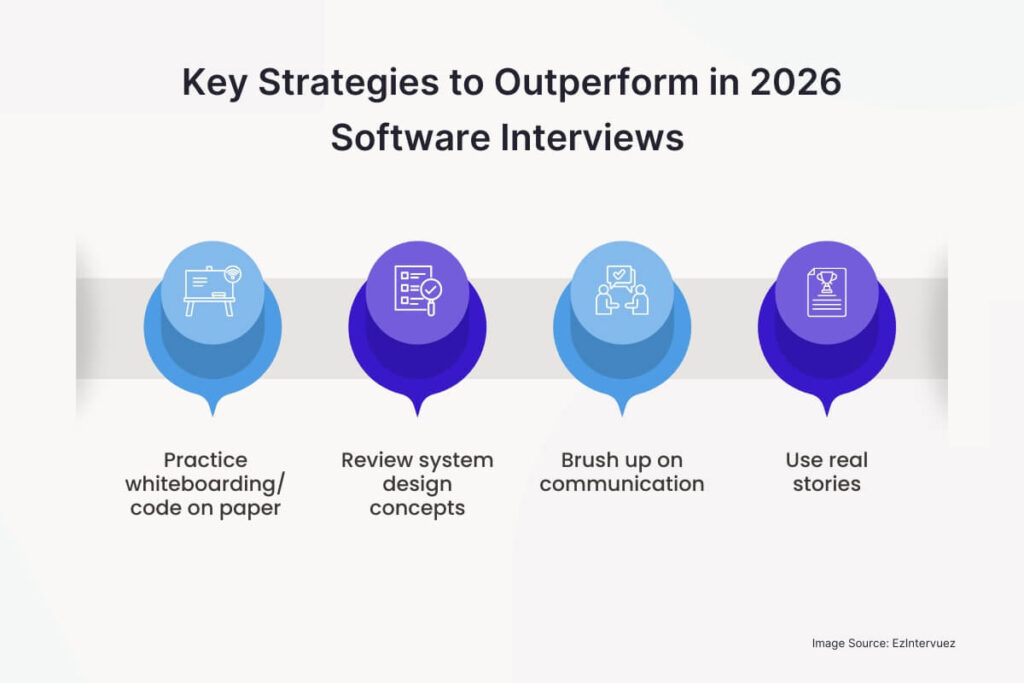
- Practice whiteboarding/code on paper: Many interviews are still in this format. Get quick at writing out syntax and talking as you code.
- Review system design concepts: Know the basics of designing distributed systems, scaling, and reliability.
- Brush up on communication: Explain decisions clearly, admit when you don’t know, and show your willingness to learn.
- Use real stories: Specifics stand out—share numbers, results, or down-to-earth anecdotes.
Want to practice these top Software Interview questions with real-time AI feedback?
How EzIntervuez Assures Your Interview Preparation
EzIntervuez is an AI powered interview platform that offers not just AI soft skills but also tests technical ones. The tool transforms the interview prep experience, blending AI-driven feedback with customizable mock interviews and real-time analytics.
The AI interview platform makes practicing core questions easy, letting you refine technical answers, improve delivery, and track progress, everything at your own pace. This approach gives candidates structured support and confidence.
Here’s how EzIntervuez can make a difference for your next interview:

- AI-Powered Interviews (Mock): EzIntervuez gives you a real-world simulation of the entire recruitment cycle. You’ll answer the standard and tough questions above with on-screen timing and instant, actionable feedback.
- Instant Skill Analysis: This AI interview platform uses speech-to-text and smart analysis to assess your communication, technical clarity, and even body language—mirroring real-world interview settings.
- Role-Specific Practice: Choose questions for your target role: frontend, backend, full stack, data science, DevOps, or more.
- Track Your Improvement: EzIntervuez is an AI interview platform that provides performance scores, detailed analytics, and video reviews so you spot and fix weak points in both coding and behavioral responses.
- Flexible, Asynchronous Mock Rounds: Asynchronous interviews means you can practice anytime, anywhere—no scheduling stress with this AI powered interview tool.
- Practice Video Resumes: Stand out by creating and reviewing your own introductory videos.
Why Use EzIntervuez?
Whether you’re a student or a job switcher, using EzIntervuez AI interview platform means stepping into your real interview feeling cool, prepared, and ready. No guesswork, just proven, AI for soft skills and technical prowess can help you sharpen both your answers and your confidence.
Ready to Crack Your Next Interview?
Investing even an hour a day on the 10 must-prepare questions that are combined with realistic mock interviews on AI powered interviews on platforms like EzIntervuez can hugely improve your performance, set you apart, and get you closer to your dream software role.
Start practicing confidently and open doors to the opportunities you deserve!
